Marine licence relating to River Tees dredging subject to suspended quashing and redetermination

The Court has today made an order for the suspended quashing of the 10 year licence granted by the Marine Management Organisation (MMO) to PD Teesport Ltd on 5 November 2025, which permits dredged material to be dumped at sea.

The Claimant, Dr Simon Gibbon, a retired industrial chemist, challenged the grant of the licence on seven grounds.

The grounds focused on the failure by the MMO to require adequate assessment of the environmental impacts of the licence, including: misapplying the OSPAR Guidelines for the Management of Dredged Material, which on Mr Gibbon’s case required the testing of far more samples than the MMO had accepted as sufficient; failing to consider alternatives to disposing of dredged material at sea; failing to require an environmental impact assessment; failing to carry out a lawful habitats assessment; and failing to take account of evidence that the dredged material was contributing to seal pup mortality in the Tees Harbour. The grounds also challenged the lawfulness of the licence due to the unenforceability of a condition excluding certain areas from dredging. Continue reading

Gatwick protest

Judicial review of Gatwick Airport expansion decision

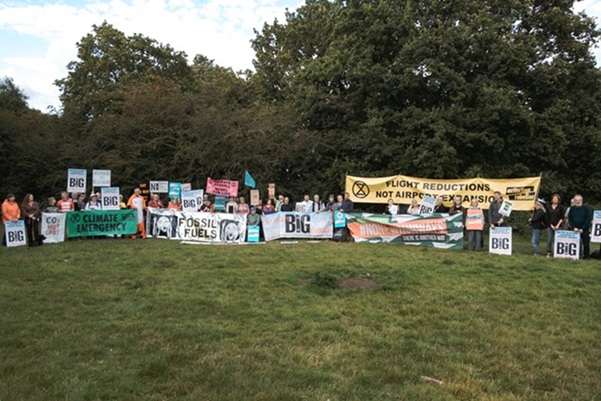
The judicial review against the government’s decision to approve the expansion of Gatwick Airport will commence tomorrow in the High Court in London. The case will be heard over 4 days (20-23 January 2026) before Mr Justice Mould.

The proposed expansion of the airport will enable the dual operation of a second runway at Gatwick and facilitate an increase of approximately 13.2 million passengers.

Two claims have been brought against the decision, by Peter Barclay (Chairman of the Gatwick Area Conservation Campaign) and CAGNE.

The claims challenge the decision on climate change, economic, interpretation of national policy and noise grounds.

Peter Barclay of GACC is represented by Goodenough Ring Solicitors, who have instructed Alex Goodman KC (Landmark Chambers) and Gethin Thomas (39 Essex Chambers).

Photo wwag

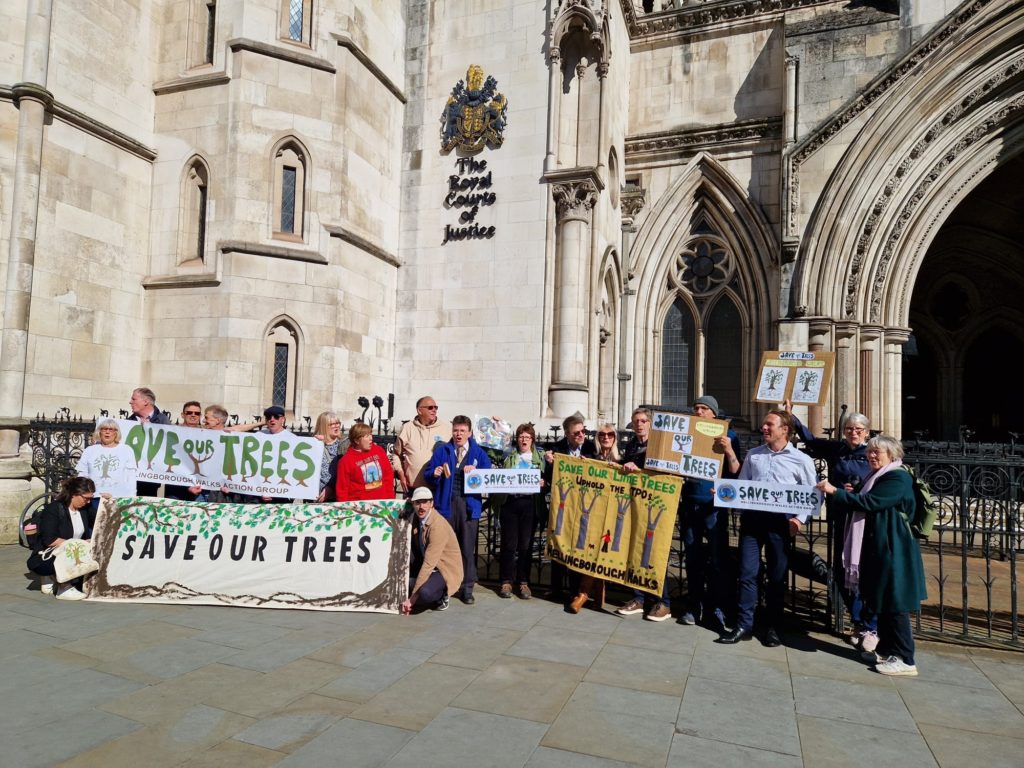
Campaigners secure important tree protections

R (Wellingborough Walks Action Group) v North Northamptonshire Council & Stanton Cross Developments LLP [2024] EWHC 1225 (Admin)

The High Court has confirmed that the tree preservation regime and planning regime must work hand in hand and that developers relying on the planning permission exception to the tree preservation regime do not have free rein.

This is welcome news for environmental campaigners, particularly those in Wellingborough and members of WWAG, some of whom were arrested and cautioned by the Police for protecting the beloved ‘Walks’, an historic boulevard of lime trees.

Dan Kolinsky KC, sitting as a deputy High Court judge, clarified that, “[t]o the extent that the planning permission can be carried out in a way which does not necessitate the loss of trees, then the exception will not be available”. In other words, the requirement for any felling to be ‘necessary’ to implement a planning permission (regulation 14 of the Town and Country Planning (Tree Preservation)(England) Regulations 2012), is a strict one.

The judgment also confirms that all relevant planning conditions must be discharged before the exception can be relied upon. This is not only correct in law it is also pragmatic, given that it may assist in determining whether it is indeed ‘reasonably possible’ to save further trees.

This judgment should act as a reminder to local authorities, including NNC, that they have a vital role to play in safeguarding protected trees and must scrutinise closely developers’ claims that trees need to be felled, when in fact it is simply expedient to do so.

While no enforcement has taken place against the developer for the unlawful felling of 16 protected trees, the Court recognised the gravity of the developer’s actions in ordering the Interested Party to contribute to the Claimant’s costs.

The judgment of the High Court is available at: https://caselaw.nationalarchives.gov.uk/ewhc/admin/2024/1225

Alice Goodenough of Goodenough Ring Solicitors acted for WWAG instructing Will Upton KC of Six Pump Court Chambers.

Increased fairness in the DCO regime but no relief for Ramsgate residents and environmental campaigners

R (Dawes) v Secretary of State for Transport and RiverOak Strategic Partners Ltd [2024] EWCA Civ 560

Following the judicial review brought against the Secretary of State for Transport for the approval of a DCO granting approval for the re-opening of Manston Airport, the Court of Appeal has made an important clarification to the Infrastructure Planning (Examination Procedure) Rules 2010.

The Secretary of State and Interested Party had argued that Rule 19 of the 2010 Rules – which requires the Secretary of State to consult where new evidence or facts mean that the Minister is inclined to disagree with the examining authority – do not apply after the examining authority has published its report.

In departing from the ruling of Dove J in the High Court, Lord Justice Lewis, with whom Lord Justice Jackson and Lord Justice Warby agreed, held that Rule 19 applies at any time after the completion of the examination and before a decision is reached. This conclusion flowed from the clear wording of the Rule and ‘reflects the purpose underling the rule’, the aim of which is ‘to ensure procedural fairness’.

This is a welcome clarification and ensures increased fairness in the DCO process where the Minister intends to depart from its expert advice, as was the case here.

Regrettably for Ms Dawes, the residents of Ramsgate and climate campaigners, the Court did not find that the new evidence was a reason for the Secretary of State’s decision. Instead, the report submitted by the applicant, which relied on 24 interviews that were never published, and which the Secretary of State’s examining authority considered should be given little weight as a result, was held to be the basis for the decision.

Given the woeful economic outlook for Manston Airport, as almost every other expert agreed, it is unlikely the airport will succeed. This is, however, of limited comfort given the social and environmental harm that is likely to be caused in the interim.

Alice Goodenough of Goodenough Ring Solicitors acted for the Claimant instructing Richard Harwood KC and Gethin Thomas, both of 39 Essex Chambers.

We’ve changed our name

We are pleased to announce that the firm’s name has changed from Harrison Grant Ring to Goodenough Ring Solicitors.

The change reflects the firm’s leadership team, who are excited to continue to build the firm’s formidable reputation.

Our correspondence address and phone number remain the same.

Img 20240121 wa0000

Triumph of community engagement at planning inquiry: recognition of the benefits of biodiversity for local and wider communities

The recent rejection of planning permission, sought by Buccleuch Properties (Kettering) Ltd, for logistics warehouses on a Local Wildlife Site (LWS) north of Kettering demonstrates what a local community can achieve on behalf of their local environment.

Under the umbrella of the Save Weekley Hall Wood (SWHW) campaign and supported by the Local Wildlife Trust, detailed ecological evidence about the environmental significance of the site was gathered by dedicated volunteers over a number of months and presented to the inquiry.

Such evidence would not have otherwise been forthcoming, the Council contesting the application for various reasons but not on ecological or biodiversity grounds. This, despite the fact that the LWS, which is a lowland meadow, a habitat designated as of ‘principal importance’ under the Natural Environment and Rural Communities Act 2006 (s.41), would have been almost entirely destroyed as a result of the development. Continue reading

Cumulative impacts and carbon budgets

On 7 July 2023, Mrs Justice Thornton DBE handed down judgment in R (Boswell) v Secretary of State for Transport [2023] EWHC 1710 (Admin).

The case concerned three decisions of the Secretary of State for Transport to grant consent for three road schemes in Norfolk. In making his decision, the Secretary of State assessed the carbon emissions expected to be generated by each scheme and concluded that, when compared with the UK’s carbon budgets which span the period from 2023 to 2037, the increase in emissions from each of the three schemes (separately) is not significant (0.001%-0.004% of any carbon budget).

Continue reading